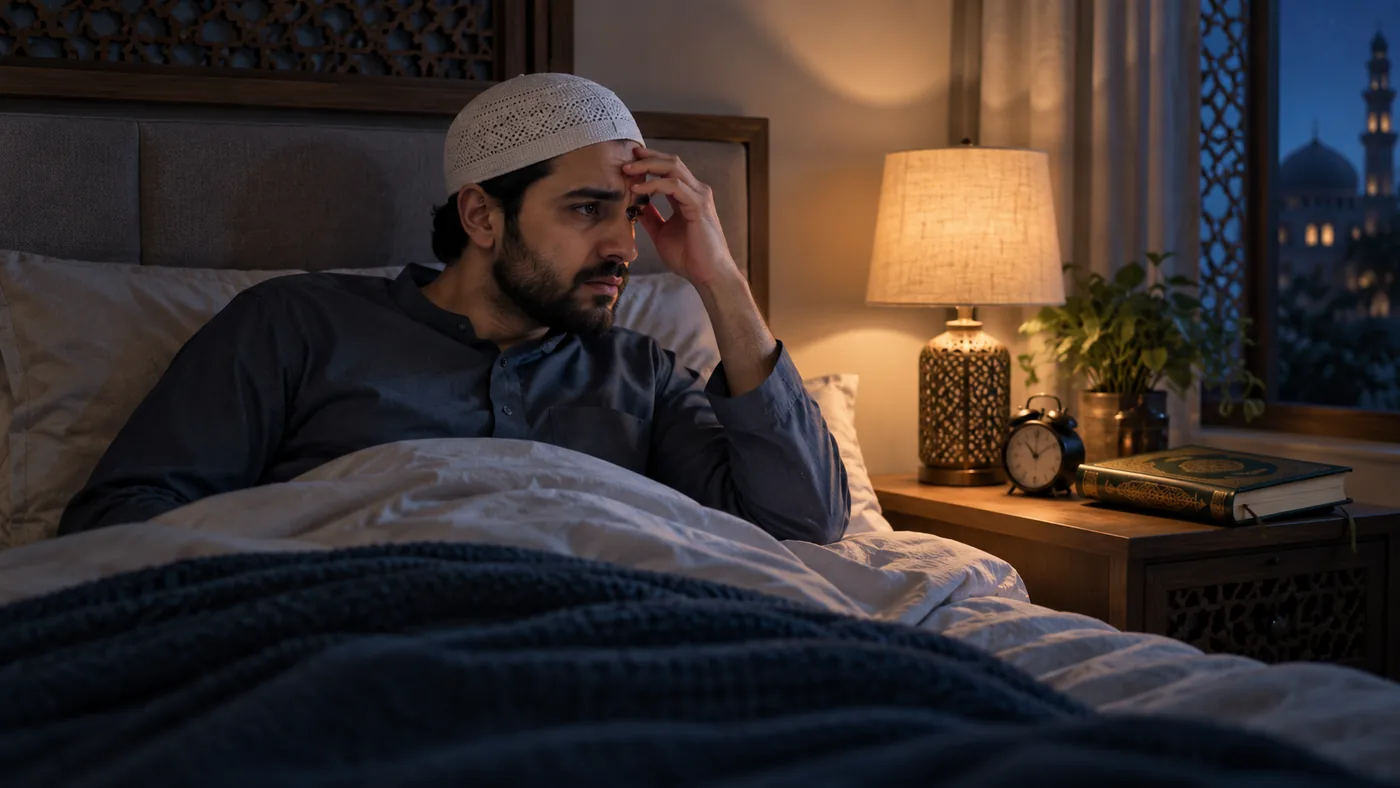
A frightening dream can feel incredibly real. When somebody already fears sihr or jinn, the dream may seem like confirmation: a face appears, a location repeats, an object is seen, or somebody says a name.
Islam recognises that dreams can have meaning. It does not teach us to use dreams as courtroom evidence against people.
What did the Prophet ﷺ say about dreams?
Authentic hadith distinguish between good dreams and disturbing dreams. Sahih al-Bukhari 6984 records that a true good dream is from Allah and a bad dream is from Satan. The Sunnah also gives a practical response to a frightening dream: seek refuge in Allah, lightly spit to the left and do not spread the dream around. See Sahih al-Bukhari 7005 and 7044.
A bad dream is not a diagnosis
The hadith teach protection from a bad dream. They do not say, “Use the dream to diagnose sihr.” If the Sunnah response is to seek refuge in Allah and not dwell on the dream, that should make us cautious about building elaborate spiritual theories from it.
Seeing a person in a dream does not prove they harmed you
This is one of the most damaging errors. Someone dreams about a relative, then a practitioner says, “That person is responsible.” Families can be destroyed by an accusation that has no evidence beyond a dream.
Qur’an 27:65 states that none in the heavens and earth knows the unseen except Allah. A dream may affect you emotionally, but it does not give you permission to accuse somebody of sihr.
What about repeated dreams?
Repetition does not automatically turn a dream into proof. People can repeat dreams when they are stressed, preoccupied, traumatised or repeatedly thinking about the same fear. A repeated dream may feel significant while still being unsuitable as evidence for a religious or personal accusation.
Can dreams guide ordinary decisions?
A good dream may encourage a person, but halal and haram are not created by dreams. Marriage, divorce, business decisions and accusations should be handled through evidence, consultation, istikharah and normal decision-making.
Istikharah does not require a dream
One common misunderstanding is that after istikharah you must see a dream or colour that tells you what to do. The Prophetic du’a of istikharah asks Allah to facilitate what is good and turn away what is harmful. The person then uses lawful means and moves forward.
What should you do after a frightening dream?
- Seek refuge in Allah from its evil and from Satan.
- Lightly spit to the left as taught in the hadith.
- Do not keep retelling it to people who will intensify your fear.
- Use your normal bedtime adhkar and protections.
- Do not accuse anyone based on the dream.
What if nightmares are frequent?
Keep the Sunnah protections, but also look at stress, trauma, medication, sleep disruption and health. Recurring nightmares can have ordinary causes. Faith does not require you to ignore them.
Three categories of dreams
Islamic texts distinguish between good dreams, disturbing dreams and ordinary dreams that can reflect a person’s own thoughts and experiences. This alone should make us cautious about treating every dream as a coded message.
Dream interpretation is not a licence to accuse
Even where a dream may carry meaning, interpretation is not certainty. A symbol can be misunderstood. A person can project their fears into the interpretation. Serious accusations need evidence that can be examined, not a private dream nobody else can verify.
Why fear makes dreams feel more convincing
If someone spends hours watching sihr and jinn content, their mind may carry those themes into sleep. A dream involving knots, snakes, graveyards or a particular relative can then feel like confirmation of what they have already been thinking about. That emotional force is not the same as proof.
Do not pay someone to “decode” every nightmare
There is no need to turn every disturbing dream into a paid consultation. The Prophetic response is simple: seek refuge in Allah, lightly spit to the left and do not dwell on the dream. The Sunnah closes the door to obsession rather than opening an industry around it.
What if a dream encourages something good?
If a dream encourages prayer, repentance or reconciliation, you can do the good action because it is already good in Islam. The dream does not create the ruling. Likewise, if a dream tells you to do something haram, harm someone or accuse another person, the dream has no authority over revelation.
Dreams and istikharah
Istikharah is often misunderstood as a dream-request ritual. The du’a asks Allah to facilitate what is good and turn away what is harmful. You may or may not see a dream. The decision still uses evidence, consultation and normal judgement.
What about dreams after ruqyah?
People sometimes report more vivid dreams after beginning ruqyah and interpret this as proof that something is being exposed. There is no authentic rule that dreams after ruqyah reveal a diagnosis. Increased attention to dreams alone can make them easier to remember.
Write it down, then step away
If a dream genuinely troubles you, write a brief note if needed, use the Prophetic response and continue your day. Replaying it repeatedly, searching every symbol and asking multiple people for interpretations can turn one night experience into weeks of anxiety.
What a responsible adviser should do
They should not use a dream to name a culprit, prescribe an occult ritual or frighten you into treatment. They can remind you of the Sunnah, help you distinguish a dream from evidence and encourage lawful action where a real-life problem exists.
Do not let dream interpretation replace evidence
If there is a real problem in a relationship, workplace or family, address what can actually be observed: words, behaviour, money, threats, dishonesty or abuse. A dream may make you reflect, but it should not replace evidence. Islam does not require people to live under accusations that cannot be tested.
Key sources
- Sahih al-Bukhari 6984, good dreams and bad dreams.
- Sahih al-Bukhari 7005 and 7044, what to do after a disturbing dream.
- Qur’an 27:65, knowledge of the unseen belongs to Allah.
Where an article discusses interpretation, diagnosis or medical safety, those points are separated from what the Qur’an and authentic Sunnah explicitly establish.
Related: Sihr in Islam and Fake Raqis and Ruqyah Scams.