



Iman gives Islam its inner foundation
In the famous hadith of Jibril, the Prophet ﷺ explained iman as belief in Allah, His angels, His Books, His Messengers, the Last Day and divine decree, its good and its difficult aspects. These beliefs form a framework for how a Muslim understands reality.

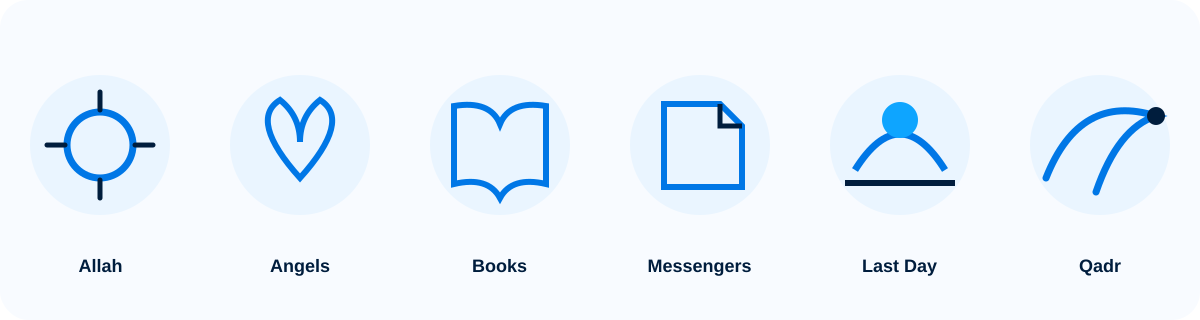
1. Belief in Allah
Allah is the Creator and only One worthy of worship. Belief in Allah includes tawhid and accepting the names and attributes He revealed without comparing Him to creation.
2. Belief in the angels
Angels are part of the unseen creation. Muslims believe in them because revelation tells us about them. Jibril is associated with revelation. Other angels have responsibilities Allah has assigned to them. We do not invent appearances or stories beyond reliable revelation.
3. Belief in the revealed Books
Muslims believe Allah revealed scripture to His messengers, including the Torah, Psalms, Gospel and finally the Qur’an. The Qur’an is the final revelation and criterion for Muslims.
4. Belief in the Messengers
Allah sent messengers to guide humanity. Muslims believe in prophets including Adam, Nuh, Ibrahim, Musa, Isa and Muhammad عليهم السلام. Muhammad ﷺ is the final Messenger. Respect for earlier prophets is therefore part of Islamic belief.
5. Belief in the Last Day
Life is not believed to end at death. Muslims believe in resurrection, judgement and the Hereafter. This gives moral weight to actions that may never receive recognition or justice in this world.
6. Belief in divine decree
Allah’s knowledge and decree encompass creation. This does not erase human responsibility. We make choices, take means and are accountable, while recognising that nothing escapes Allah’s knowledge and power.
What does qadr change in real life?
It should not make a person passive. If you are ill, seek treatment. If you need work, apply. If you have made a mistake, repair it. Tawakkul and belief in decree are not excuses to abandon action.
At the same time, qadr helps us understand that after we have taken reasonable means, outcomes are not fully under our control. That can protect a believer from endless “what if” thinking.
Faith is more than memorising six words
These beliefs should change behaviour. Belief in angels and accountability can strengthen private integrity. Belief in revelation makes us ask for evidence. Belief in Messengers makes prophetic character relevant. Belief in the Last Day helps us choose long-term accountability over short-term approval.
Where to go next
- Sahih Muslim 8a, the hadith of Jibril and the six foundations of iman.
- Qur’an 2:285, belief in Allah, angels, Books and Messengers.
- Qur’an 54:49, creation with decree.
How iman affects anxiety and uncertainty
Belief does not remove every difficult emotion. But it changes the frame. You are not living in a random universe with no accountability or purpose. Allah knows, the Hereafter exists, revelation gives guidance and outcomes are within divine decree. That framework can give stability even when circumstances are unstable.
Belief in angels without fantasy
Online culture often turns the unseen into imaginative stories. Islamic belief is more disciplined. We affirm what revelation establishes about angels and stop where the evidence stops. We do not need fictional details to make the unseen interesting.
Belief in Messengers creates continuity
Islam does not begin with Muhammad ﷺ as though no guidance existed before him. Muslims see themselves within a chain of revelation. This is why Musa and Isa عليهم السلام are honoured prophets in Islam, and why the Qur’an repeatedly tells their stories.
Belief in the Last Day should improve private behaviour
Public reputation can be managed. The Last Day cannot. Belief in judgement reminds us that hidden injustice, private sincerity, unpaid rights and unrecognised good deeds all matter even when nobody else notices them.
Qadr and responsibility
Do not use “it was written” to excuse wrongdoing. You do not know the decree before choosing. You are responsible for the choice you make, then you trust Allah regarding what happens beyond your control.