

You do not need to become an expert in a week
One of the fastest ways to burn out is to treat Islam like an exam with thousands of facts you must master immediately. The religion has depth, but your learning can have an order.
Step 1: get the belief foundation clear
Understand tawhid, the role of the Prophet Muhammad ﷺ, the Qur’an and the six foundations of iman. This gives everything else context.
Step 2: learn purification and prayer
Wudu and salah should become an early practical priority. Use a reliable step-by-step guide and ask a trustworthy person to watch your prayer if you need feedback.
Step 3: build a small Qur’an habit
Read translation and learn short surahs. Ten consistent minutes often beats a dramatic two-hour session once every few weeks.
Step 4: learn basic halal and haram gradually
Some matters require immediate attention, but do not spend all your time hunting for forbidden things. Learn the major obligations and major prohibitions from reliable sources, then build detail as your life requires it.
Step 5: find healthy company
A good mosque, teacher or Muslim friend can make learning easier. Healthy community should help you worship Allah, not pressure you into adopting every cultural habit or online dispute.
Step 6: protect yourself from information overload
Following fifty Islamic accounts does not mean you are learning well. Choose a small number of reliable resources. Keep notes. Study one topic at a time. Separate reminders from structured learning.
Your first month
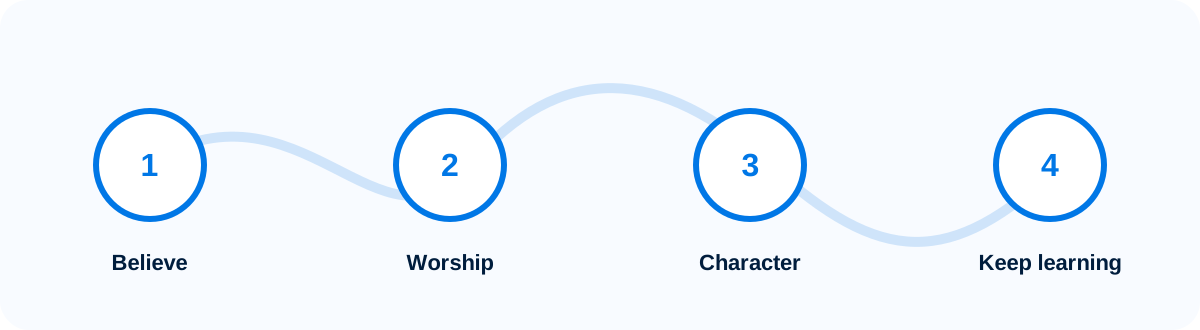
Belief
Islam, Allah, Messenger, Qur’an.
Prayer
Wudu, five prayers, al-Fatihah.
Daily habits
Qur’an, du‘a, dhikr and routine.
Character
Speech, honesty, family and consistency.
What about sects and differences of opinion?
You will encounter labels early. Do not let every disagreement become your first subject. Learn the Qur’an and authentic Sunnah with trustworthy teachers. When recognised scholars differ on secondary matters, learn to distinguish legitimate disagreement from clear contradiction of evidence.
Do not confuse culture with religion
Muslim communities have cultures, foods, clothes and social expectations. Some are beautiful. Some are simply local custom. Islam does not require you to become culturally Arab, Pakistani, Somali, Turkish or anything else.
Protect your heart from comparison
You will meet Muslims who know more Arabic, memorise more Qur’an or have practised longer. That is not a reason to feel fake. Compare yourself to yesterday’s version of you and keep moving.
What to do when you hear conflicting advice
Write the question down. Ask whether it is a foundation, a personal ruling or a secondary difference. Check a reliable source rather than letting the loudest comment decide. If the issue affects marriage, money, health or legal responsibility, speak to someone qualified.
How much Arabic should I learn?
Start with what prayer requires and the meanings of what you recite. Then build slowly. Arabic is valuable, but lack of fluency should not block you from understanding Islam in English today.
What about friends and old habits?
Some relationships will support your growth and others may constantly pull you backwards. You do not need to become cold or self-righteous. But you may need boundaries around places, conversations or routines that repeatedly damage your progress.
Celebrate progress without becoming complacent
Notice what changed. Maybe you now pray Fajr consistently, understand al-Fatihah or stopped a damaging habit. Thank Allah for progress, then keep building. Gratitude is healthier than either arrogance or permanent self-criticism.
Build a personal reference folder
Save your prayer guide, a reliable Qur’an translation, the Start Here page and the contact details of a trustworthy local person. When a question appears, you then have a small reliable toolkit instead of beginning with a random search every time.
Make room for joy
Learning Islam should include gratitude, community, good food, nature, exercise, family and lawful hobbies. A beginner journey made entirely of warnings can become distorted. Islam gives boundaries, but it also teaches thankfulness for lawful blessings.
At three months, review rather than restart
Ask what is now stable, what is still confusing and what one area needs deeper learning next. Do not throw away your whole routine because it is imperfect. Keep the parts that work and improve one weak point at a time.