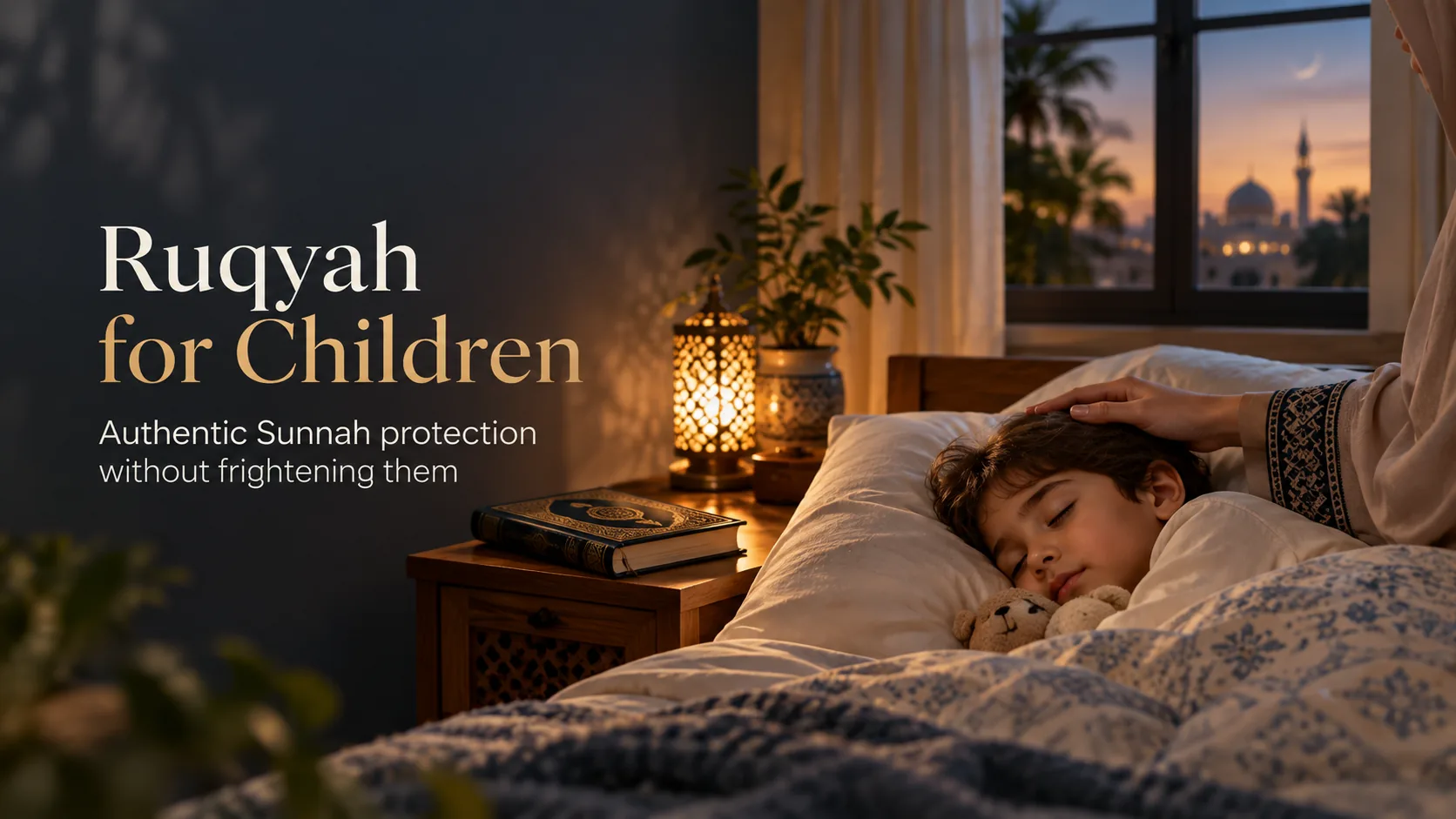
Children should learn that Allah protects them. They should not grow up believing the unseen is waiting around every corner to attack them.
Authentic ruqyah for children is simple, gentle and rooted in the Sunnah.
The Prophet ﷺ protected al-Hasan and al-Husayn
Ibn ‘Abbas رضي الله عنهما reported that the Prophet ﷺ used to seek protection for al-Hasan and al-Husayn with:
أَعُوذُ بِكَلِمَاتِ اللَّهِ التَّامَّةِ مِنْ كُلِّ شَيْطَانٍ وَهَامَّةٍ وَمِنْ كُلِّ عَيْنٍ لَامَّةٍ
A‘udhu bi kalimatillahi al-tammati min kulli shaytanin wa hammatin wa min kulli ‘aynin lammah.
This asks refuge in Allah’s perfect words from every devil, harmful creature and harmful eye. See Sahih al-Bukhari 3371.
Children can be protected without being told frightening stories
A young child does not need to hear:
- “There is a jinn in your room.”
- “Someone gave you evil eye.”
- “Your nightmares mean possession.”
- “Do not go there because spirits live there.”
Those ideas can create long-term fear and anxiety.
Teach the protection, not the panic.
A simple bedtime routine
Parents can help children build a calm routine:
- Make wudu where appropriate.
- Recite Ayat al-Kursi.
- Recite al-Ikhlas, al-Falaq and al-Nas.
- Use the prophetic protection du‘a.
- Make ordinary bedtime du‘a.
- Sleep in a calm environment.
The Prophet ﷺ himself used the three surahs before sleep, blowing into his hands and wiping over his body three times. See Sahih al-Bukhari 5017.
Morning and evening protection
Sunan Abi Dawud 5082 records reciting al-Ikhlas, al-Falaq and al-Nas three times morning and evening.
Older children can gradually memorise this routine themselves. The goal is to build confidence in worship, not dependence on a parent or raqi.
What if my child has nightmares?
Children have nightmares for many reasons. A frightening dream is not proof of jinn or evil eye.
Comfort the child. Use the established adhkar. Look at stress, frightening content, sleep routines and anything happening at school or home.
If nightmares are frequent, severe or linked to trauma or significant distress, seek appropriate professional support.
What if my child behaves differently during Qur’an?
A child may become bored, restless, emotional, frightened or resistant when adults around them are treating the recitation like an exorcism.
Do not turn normal childhood behaviour into a spiritual diagnosis.
Keep recitation calm. If there is a genuine health or behavioural concern, investigate it properly.
What about autism, ADHD or developmental differences?
Neurodevelopmental conditions must not be relabelled as possession.
A child can receive ruqyah and du‘a because all Muslims benefit from Qur’an and protection. But that should sit alongside appropriate educational, developmental and medical support.
What if a child has a seizure?
Do not assume possession.
NHS guidance treats a first seizure, a seizure lasting more than five minutes, repeated seizures without recovery and breathing difficulty as situations requiring urgent medical attention.
Keep the child physically safe and seek help. Do not restrain them violently or put anything into their mouth.
Can a parent perform ruqyah for a child?
Yes. A parent can recite Qur’an and prophetic du‘as over their child.
You do not need to take a child to a stranger simply because they have nightmares, anxiety or unexplained symptoms.
Should children be taken to a raqi?
Sometimes families may seek help from a trustworthy person who recites Qur’an. If so, the same safeguards apply:
- the parent should remain present;
- no inappropriate touching;
- no beating, shouting or frightening;
- no secret rituals;
- no accusations against relatives;
- no stopping medical treatment;
- no filming or public humiliation.
Never film a vulnerable child for ruqyah content
Children cannot meaningfully consent to having frightening or distressed moments turned into social-media material.
A dramatic “jinn reaction” clip may bring views, but it can remain online for years and affect that child’s dignity.
Protect their honour.
Teach them what to say when afraid
Give children words of remembrance rather than frightening explanations. Teach them that Allah hears them, Allah protects them and the Qur’an is a source of comfort.
When they are old enough, teach the morning and evening adhkar gradually.
What authentic ruqyah for children does not need
- special jewellery or amulets;
- secret symbols;
- salt around the bed;
- unknown oils sold as necessary;
- a practitioner shouting at the child;
- questions directed to a supposed jinn;
- long sessions that terrify or exhaust the child.
When ordinary parenting is the answer
Sometimes the child needs:
- more sleep;
- less frightening media;
- a calmer home;
- consistent boundaries;
- attention and reassurance;
- medical review;
- support at school;
- therapy after a difficult experience.
Using those means does not weaken faith.
A healthy Islamic message for children
The unseen exists. Allah is greater.
We recite Qur’an because we love and trust Allah, not because we spend our lives terrified of jinn.
Key sources
- Sahih al-Bukhari 3371
- Sahih al-Bukhari 5017, 5010
- Sunan Abi Dawud 5082
- Sahih Muslim 2200
- NHS seizure guidance for medical safety
Where an article discusses interpretation, diagnosis or medical safety, those points are separated from what the Qur’an and authentic Sunnah explicitly establish.
Related: Authentic Ruqyah Guide and The Evil Eye in Islam.