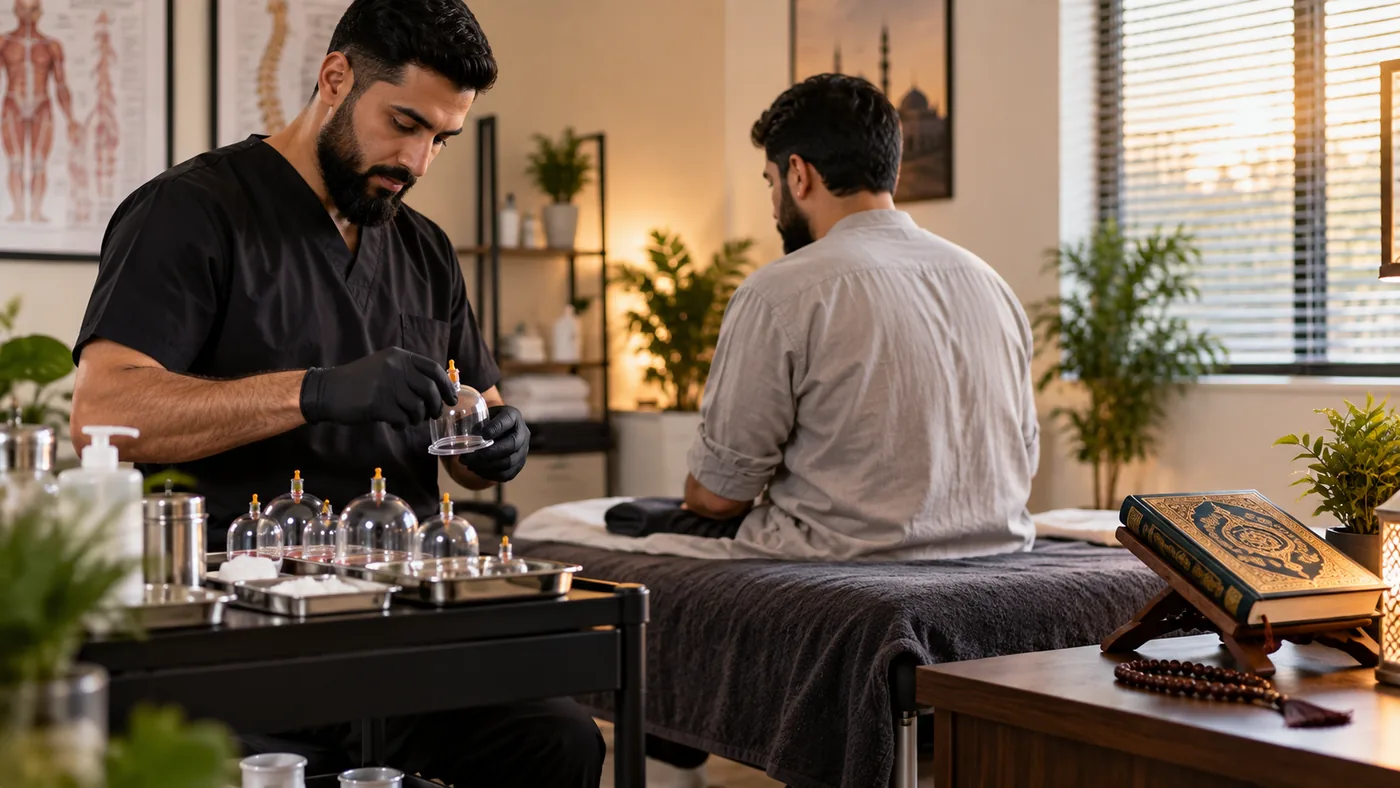
A Muslim can believe in ruqyah and still see a doctor. A Muslim can believe in the evil eye and still seek mental-health support. A Muslim can believe in jinn and still treat epilepsy, migraine, trauma, psychosis or anxiety as real health conditions.
The idea that spiritual treatment and medical treatment must compete with each other is not a Sunnah principle.
The Prophet ﷺ encouraged treatment
Abu Hurayrah رضي الله عنه reported that the Prophet ﷺ said Allah did not create a disease except that He also created its treatment. See Sahih al-Bukhari 5678.
Sunan Abi Dawud 3855 also records the instruction to seek medical treatment.
At the same time, the Prophet ﷺ used du‘a and ruqyah. There is no contradiction.
Why people sometimes avoid medical care
Fear-based ruqyah content can create a dangerous story:
- “Doctors only treat symptoms.”
- “Medication blocks spiritual healing.”
- “Therapy will make the jinn stronger.”
- “If Qur’an makes you react, the problem cannot be medical.”
These claims can delay care and make vulnerable people dependent on practitioners.
Ruqyah is worship, not a replacement diagnostic system
Ruqyah can be performed when someone is physically ill, emotionally distressed, afraid of evil eye or simply seeking Allah’s protection.
You do not need to prove a supernatural diagnosis before reciting Qur’an and making du‘a.
That means there is no benefit in forcing every symptom into “medical” or “jinn” before you are allowed to act. Use lawful spiritual means and lawful medical means together.
Hallucinations and hearing voices
Hearing voices, seeing things others cannot see or feeling things that are not there can occur with a range of health conditions. NHS guidance advises people experiencing hallucinations to seek medical help.
If someone is hearing commands to harm themselves or others, is rapidly deteriorating, severely agitated or suddenly confused, urgent help may be required.
Do not tell a person in this condition simply to stop medication and “increase ruqyah”.
Seizures
A seizure can be frightening to witness and may be mislabelled as possession.
NHS guidance advises emergency help in situations including a first seizure, a seizure lasting more than five minutes, repeated seizures without recovery, serious injury or breathing difficulty.
During a seizure, keep the person safe. Do not put objects in their mouth. Do not restrain them violently.
You can make du‘a without obstructing medical care.
Panic attacks and intense fear
Panic can cause shaking, chest tightness, dizziness, breathlessness, tingling, nausea and feelings of unreality. If someone has already been told they are possessed, those sensations may be interpreted as “the jinn reacting”.
This can create a cycle: fear produces symptoms, symptoms are called possession, the diagnosis produces more fear.
Ruqyah may be comforting and spiritually beneficial, but the person may also need support for anxiety.
Sleep problems
Nightmares, sleep paralysis, insomnia and waking suddenly can be deeply unsettling. Use bedtime adhkar and the prophetic protections, but also look at sleep deprivation, stress, medication, caffeine and sleep disorders.
Depression and low iman are not the same thing
A person with depression may struggle to pray, concentrate or feel spiritual motivation. Telling them they simply have weak iman can increase guilt and delay support.
Encourage worship gently, but do not turn illness into a moral judgement.
When a raqi tells you to stop treatment
Ask what qualification gives them the authority to discontinue medical treatment.
A raqi may make du‘a and recite Qur’an. That does not make them a doctor, psychiatrist or pharmacist.
If medication is causing a problem, discuss it with the clinician responsible for it. Do not stop certain medications suddenly without advice.
Can medical treatment weaken tawakkul?
No. Tawakkul means relying upon Allah while using permissible means.
We eat when hungry, drink when thirsty and seek shelter when cold. Using treatment is another means Allah has made available.
A balanced approach when you are unsure of the cause
- Keep salah.
- Make du‘a for healing.
- Perform simple self-ruqyah.
- Use morning and evening adhkar.
- Record symptoms clearly.
- Seek medical assessment where appropriate.
- Seek mental-health support where appropriate.
- Avoid practitioners who claim certainty about the unseen.
- Do not stop prescribed treatment without medical advice.
What a trustworthy imam or raqi should say
A balanced helper should be comfortable saying:
- “I do not know whether this is supernatural.”
- “Let us recite Qur’an and make du‘a anyway.”
- “Please see your GP about those symptoms.”
- “Do not stop your medication.”
- “You can continue self-ruqyah at home.”
Uncertainty is not weakness. Pretending certainty about the unseen is the greater danger.
When to seek urgent help
Seek urgent medical help if there is immediate danger, including serious injury, difficulty breathing, prolonged seizure, severe confusion, rapidly worsening hallucinations, or thoughts or voices telling someone to harm themselves or others.
In the UK, NHS 111 can provide urgent advice, and 999 or A&E is appropriate for emergencies.
Ruqyah should make a person safer, not less safe
Authentic ruqyah turns the heart towards Allah. It should not isolate a person from family, doctors, medication or reality.
If a form of “ruqyah” is making someone more frightened, more dependent, less medically safe or more suspicious of everyone around them, something has gone wrong.
Key sources
- Sahih al-Bukhari 5678, 5675
- Sunan Abi Dawud 3855
- Sahih Muslim 2200, 2202
- NHS guidance on hallucinations, psychosis and seizures
Where an article discusses interpretation, diagnosis or medical safety, those points are separated from what the Qur’an and authentic Sunnah explicitly establish.
Related: Jinn Possession: What Islam Actually Teaches and Authentic Self-Ruqyah Guide.