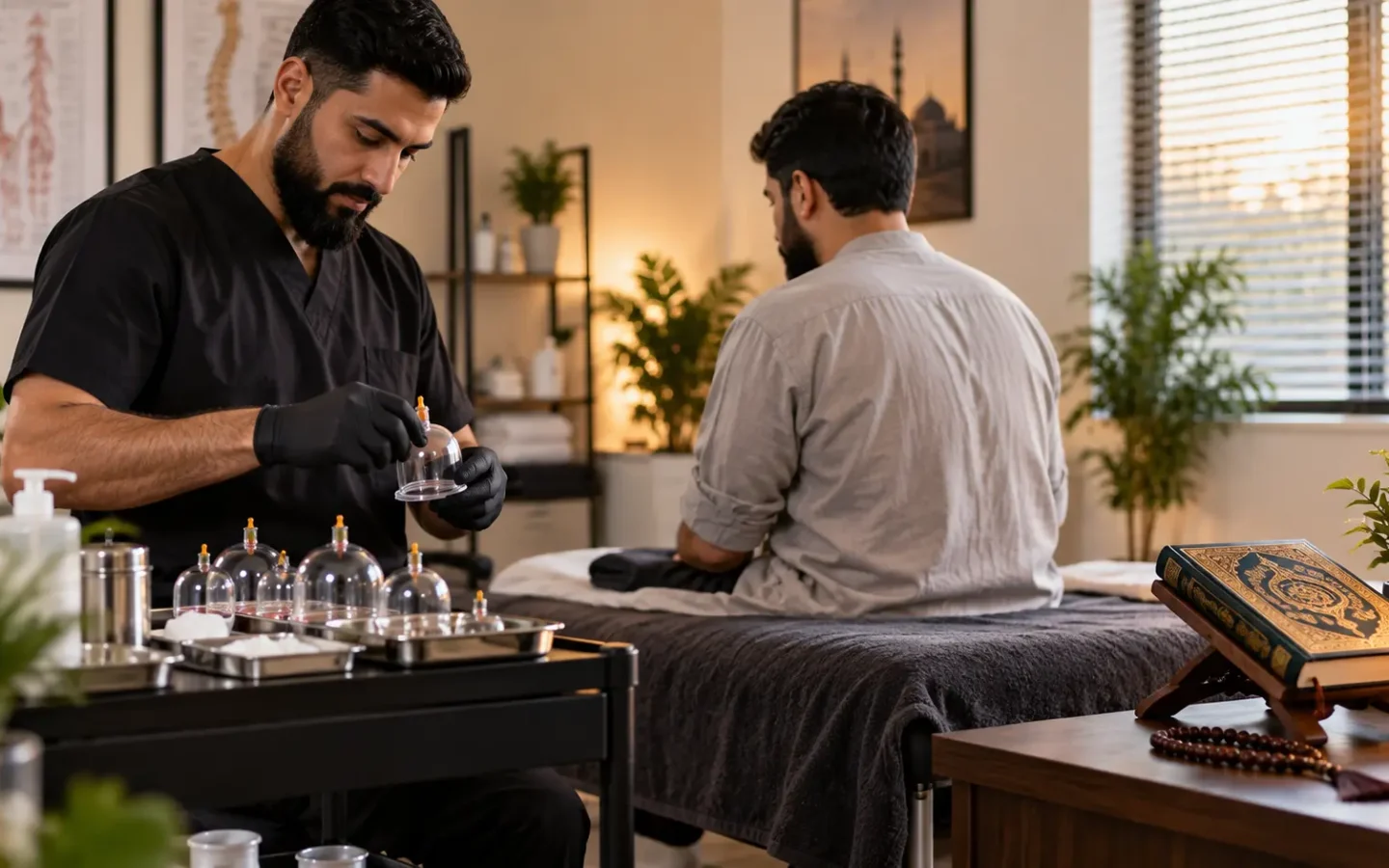
Quick answer: Hijama and ruqyah are two different practices. Ruqyah is Qur’an and authentic supplication used while seeking Allah’s protection and healing. Hijama is wet cupping, a physical treatment that is established in authentic hadith. A Muslim may choose to use both, but there is no authentic basis for treating hijama as a test that diagnoses sihr, evil eye or jinn possession.
This distinction matters because online discussions often blur the two. Someone feels spiritually unsettled, books hijama, reacts strongly during or after the session, and is then told that the cups have “pulled out sihr” or proved an unseen diagnosis. That goes beyond what the Qur’an and authentic Sunnah establish.
What is ruqyah?
Ruqyah is recitation and supplication used while asking Allah for protection and healing. The clearest governing principle is the statement of the Prophet ﷺ in Sahih Muslim 2200: there is no harm in ruqyah so long as it contains no shirk.
That means authentic ruqyah centres on Qur’an, known supplications, tawhid and reliance upon Allah. It does not need secret symbols, occult calculations, unknown names, spirit communication or dramatic rituals.
What is hijama?
Hijama is wet cupping. It involves placing cups on the skin, creating suction and then making small superficial incisions so a limited amount of blood is drawn into the cups.
Cupping is established in authentic hadith as a form of treatment. Sahih al-Bukhari 5696 records that the Prophet ﷺ was cupped and described cupping among beneficial treatments. Sahih Muslim 1577b also records praise of cupping as a treatment.
That gives hijama a legitimate place in Islamic tradition. It does not, however, automatically make every modern claim attached to hijama authentic.
Can hijama and ruqyah be used together?
Yes, in the simple sense that a Muslim may recite Qur’an and make du’a while also choosing lawful physical treatment. Islam does not require spiritual means and physical means to compete with each other.
A person may perform self-ruqyah, maintain morning and evening adhkar, recite Qur’an and also book hijama because they value cupping as part of their wellbeing routine.
The important point is to keep the roles clear:
- Ruqyah: Qur’an, du’a and seeking Allah’s protection and healing.
- Hijama: a physical wet-cupping treatment.
- Diagnosis of the unseen: neither hijama marks, blood appearance nor bodily reactions give a practitioner independent knowledge of sihr, jinn or evil eye.
Does hijama remove sihr?
There is no authentic hadith that gives Muslims a general rule saying hijama removes sihr from the body.
Sihr is real in Islamic revelation, and authentic ruqyah is a legitimate response. Hijama is also an established treatment. But joining those two facts together does not create a third rule that “hijama removes sihr”.
If someone feels better after hijama, that experience can be acknowledged without converting it into a claim about the unseen. Improvement does not tell us with certainty what caused the original problem.
Do dark hijama marks prove evil eye or sihr?
No. Cupping marks vary for ordinary physical reasons, including suction strength, duration, skin response and individual differences.
A darker mark is not a spiritual test. The Qur’an and Sunnah do not teach a colour chart where purple means sihr, red means evil eye or one side of the body identifies a jinn.
This is exactly the kind of claim that can turn a useful physical treatment into fear-based diagnosis.
What about unusual blood during hijama?
The appearance of blood during wet cupping should not be used as evidence of unseen harm either.
A practitioner may describe what they observe physically, but statements such as “this blood proves black magic” or “this clot came from evil eye” need evidence. Without revelation establishing that diagnostic method, such claims should not be presented as Islamic fact.
What does the Qur’an mean when it describes healing?
Qur’an 17:82 describes the Qur’an as healing and mercy for the believers. This is a powerful foundation for turning to the Qur’an for guidance, comfort and ruqyah.
It does not mean every wellness treatment becomes part of ruqyah, nor does it allow practitioners to create new unseen diagnostic systems around bodily signs.
Can you recite ruqyah during a hijama session?
A Muslim may recite Qur’an and make authentic du’a at any appropriate time, including before or around a treatment session. There is no problem with remembering Allah.
What should be avoided is presenting a particular combined ritual as Sunnah unless there is evidence for that exact practice. For example, if somebody says a particular surah must be recited exactly seven times while cups are placed on a specific body point to break sihr, that specific formula needs evidence.
Should a hijama practitioner diagnose jinn, sihr or evil eye?
No practitioner should claim certainty about the unseen because of hijama marks, pain, blood appearance or how a client reacts.
Qur’an 27:65 states that none in the heavens and earth knows the unseen except Allah. Experience in cupping does not give someone access to hidden spiritual causes.
A careful practitioner can say:
- “This is what I can observe physically.”
- “Hijama is not a test for sihr or possession.”
- “You are welcome to maintain authentic ruqyah separately.”
- “Please seek medical assessment where symptoms need it.”
Can hijama replace medical treatment?
No. A person should not stop prescribed medication or avoid appropriate medical assessment because they have chosen hijama or ruqyah.
The Prophet ﷺ encouraged treatment. Sahih al-Bukhari 5678 states that Allah has created treatment for disease. Spiritual practice and ordinary healthcare can be used together.
If symptoms involve severe pain, fainting, seizures, breathing problems, persistent mental-health symptoms or anything medically concerning, those need appropriate professional assessment.
Why this topic attracts misinformation
Ruqyah, sihr and jinn content attracts attention because fear is powerful. Hijama is visually dramatic too. Combining the two can make very compelling social-media content.
That does not make the claims accurate.
Common unsupported claims include:
- “Hijama on this point removes jinn.”
- “Dark blood proves sihr.”
- “A client shaking under the cups proves possession.”
- “Hijama must be performed on a particular date to remove magic.”
- “You need repeated sessions until the spiritual problem is fully extracted.”
Muslims should ask a simple question: what is the evidence for this specific claim?
A balanced approach if you are considering both
- Keep the five daily prayers.
- Use authentic self-ruqyah with Qur’an and established supplications.
- Maintain morning and evening adhkar.
- If you choose hijama, treat it as hijama rather than as an unseen diagnostic test.
- Use a trained practitioner with good hygiene and clear boundaries.
- Do not allow anyone to tell you who allegedly performed sihr based on cupping marks or reactions.
- Use medical or mental-health care where symptoms require it.
What should you expect from a responsible hijama clinic?
A responsible clinic should explain the physical treatment clearly, use appropriate hygiene, discuss suitability and avoid making claims it cannot establish.
For an example of this boundary-led approach, see Herts Cupping’s guide to Hijama alongside Ruqyah and spiritual wellbeing. Their page explicitly separates Qur’anic ruqyah from physical hijama and states that hijama is not used to diagnose the unseen.
Frequently asked questions
Is hijama part of ruqyah?
No. They are separate practices. Ruqyah is Qur’an and authentic supplication. Hijama is wet cupping.
Can I do ruqyah before or after hijama?
Yes. There is no problem with reciting Qur’an and making du’a while also using lawful treatment.
Can hijama marks diagnose evil eye?
No authentic source establishes cupping-mark colour or location as a diagnostic test for evil eye.
Can a hijama practitioner tell me I have sihr?
They should not claim certainty about the unseen based on hijama findings or reactions.
Does hijama cure jinn possession?
There is no authentic general rule saying hijama cures possession. If a Muslim fears unseen harm, authentic ruqyah remains the clearest source-based spiritual practice.
Should I stop medication if I am doing hijama and ruqyah?
No. Do not stop prescribed treatment without appropriate medical advice.
Key sources
- Sahih Muslim 2200: ruqyah is permissible when free from shirk.
- Qur’an 17:82: the Qur’an as healing and mercy for believers.
- Sahih al-Bukhari 5696: cupping as a treatment.
- Sahih Muslim 1577b: praise of cupping as treatment.
- Sahih al-Bukhari 5678: treatment for disease.
- Qur’an 27:65: knowledge of the unseen belongs to Allah.
Where an article discusses interpretation, diagnosis or medical safety, those points are separated from what the Qur’an and authentic Sunnah explicitly establish.
Continue reading: Authentic Ruqyah in Islam, Fake Raqis and Ruqyah Scams, and Ruqyah and Medical Treatment.