
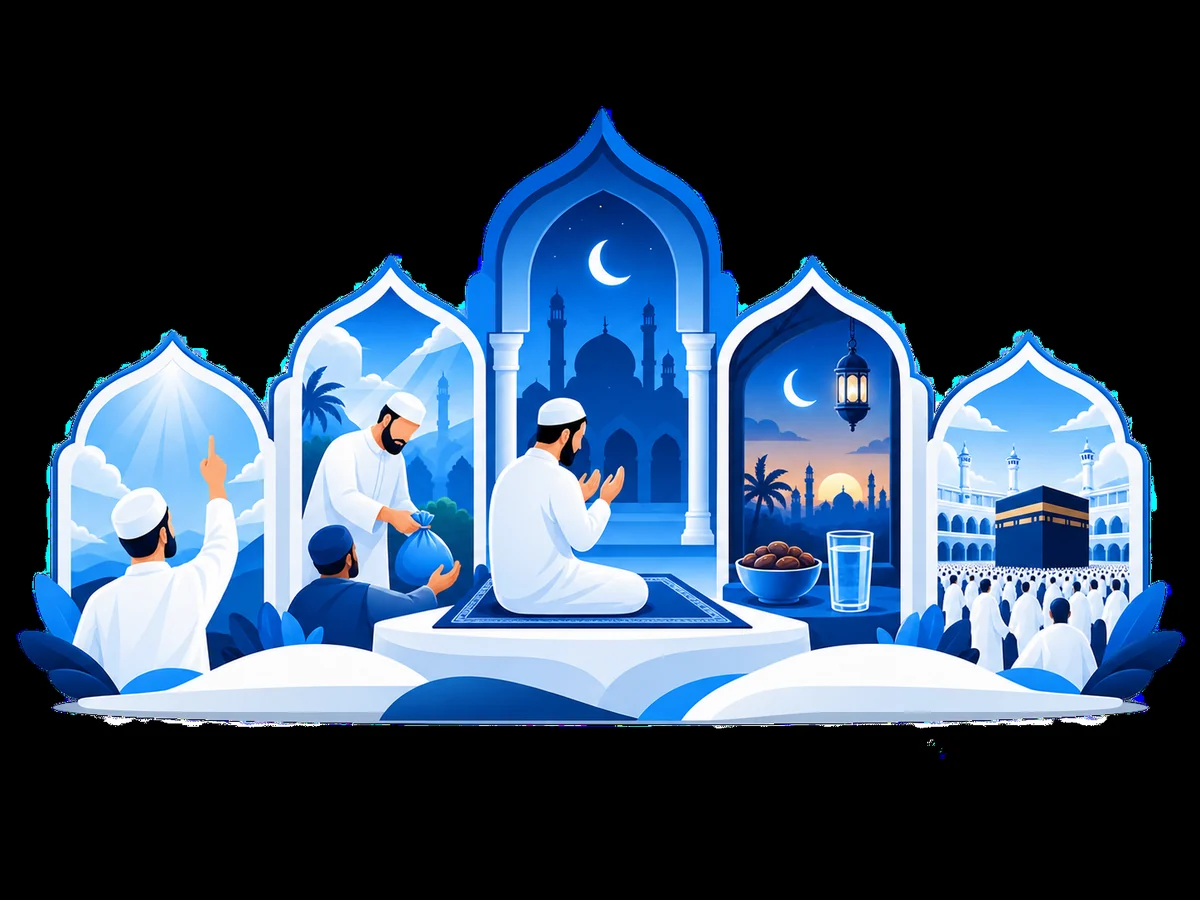
The Five Pillars give Muslim life structure
The Five Pillars are not the whole of Islam, but they are the major acts that hold Muslim practice together. The Prophet ﷺ summarised them in Sahih al-Bukhari 8. A beginner who understands these five has a clear map of the practical foundations.
1. Shahadah: the testimony of faith
The Shahadah affirms that none has the right to be worshipped except Allah and that Muhammad ﷺ is the Messenger of Allah. It is not a slogan detached from life. It changes who you worship and whose guidance you accept.
For someone entering Islam, the Shahadah is the doorway. For someone born Muslim, its meaning is something to renew in understanding throughout life.
2. Salah: the five daily prayers
Prayer divides the day around remembrance of Allah: Fajr, Dhuhr, ‘Asr, Maghrib and ‘Isha. It involves recitation, standing, bowing, prostrating and sitting. The physical movements matter, but so does khushu, the humility and attentiveness we try to bring into the prayer.
If prayer feels difficult at first, learn it in layers. Learn wudu, then the movement sequence, then the essential recitations. Keep improving rather than waiting until you can perform everything perfectly.
3. Zakah: obligatory charity
Zakah is a financial obligation on qualifying wealth. It teaches that money is a trust and that society has responsibilities towards people in need. The detailed calculations depend on the type and amount of wealth, so this is one area where specific personal questions should be checked with knowledgeable guidance.
4. Fasting Ramadan
During Ramadan, Muslims who are required and able to fast abstain from food, drink and other things that invalidate the fast from dawn to sunset. But fasting is not simply hunger. It trains restraint, gratitude, worship and awareness of Allah.
There are exemptions and detailed rulings for illness, pregnancy, travel and other circumstances. Beginners should learn the basic obligation while seeking qualified advice for personal cases.
5. Hajj: pilgrimage to Makkah
Hajj is required once in a lifetime for Muslims who are physically and financially able. Millions gather in worship through rites connected to Ibrahim عليه السلام and the prophetic tradition. Hajj strips away many visible status differences and reminds believers of return, accountability and the unity of worship.
How the pillars work together
Each pillar trains something different. Shahadah gives direction. Salah gives rhythm. Zakah trains responsibility with wealth. Fasting trains self-control. Hajj gathers belief, sacrifice and community into an extraordinary act of worship.
They also protect against a common problem: turning faith into feelings only. Islam gives repeated actions that bring belief back into the body and calendar.
What if I cannot do everything at once?
If you are new, learn priorities. The Shahadah and prayer require early attention. Ramadan comes at its time. Zakah depends on qualifying wealth. Hajj depends on ability. Do not confuse “I have more to learn” with “I should do nothing until I know everything”.
- Sahih al-Bukhari 8, Islam is built on five.
- Qur’an 2:183, fasting prescribed.
- Qur’an 3:97, Hajj for those able.
The pillars are connected, not isolated tasks
Shahadah gives the direction of worship. Prayer repeatedly renews that direction. Zakah challenges selfishness with wealth. Fasting teaches restraint when nobody needs to know whether you broke it. Hajj gathers sacrifice, remembrance, equality and history into one journey. Together, the pillars train different parts of a Muslim’s life.
Do all five apply to every Muslim in exactly the same way?
No. Shahadah and prayer are foundational for every accountable Muslim, but zakah only applies when qualifying wealth reaches the relevant conditions. Fasting has exemptions and make-up rules for particular circumstances. Hajj is required only for those who are able. This is why a simple list of five should not replace learning the conditions of each pillar.
How to teach the pillars to children or new Muslims
Connect each pillar to a meaning, not just a word. Shahadah means who we worship. Salah means returning to Allah throughout the day. Zakah means wealth comes with responsibility. Ramadan means learning restraint. Hajj means answering Allah’s call and remembering the legacy of Ibrahim عليه السلام.
A practical self-check
Ask yourself which pillar needs most attention right now. If prayer is inconsistent, focus there before building ten optional routines. If Ramadan is approaching, learn the basic rulings early. If your wealth may qualify for zakah, do not guess the calculation. Get reliable help.
Why these five are called pillars
The Prophet ﷺ described Islam as being built on five foundations. A pillar is not the whole building, but without the pillars the structure is unstable. The Five Pillars organise a Muslim’s relationship with Allah, time, wealth, self-discipline and community.
Who is responsible for each pillar?
The Shahadah is the foundation for every Muslim. The five daily prayers are obligatory for accountable Muslims, with specific exemptions and concessions recognised in Islamic law. Zakah only applies when wealth meets its conditions. Ramadan fasting has exemptions for circumstances such as illness and travel, with details depending on the case. Hajj is required once in a lifetime for the person who is genuinely able to undertake it.
This matters because beginner summaries can make people think every pillar applies in exactly the same practical way to every person at every moment.
How the pillars train different parts of life
- Shahadah trains loyalty and direction: who you worship and whose message you follow.
- Salah trains time and repeated return to Allah.
- Zakah trains the relationship with wealth and responsibility to others.
- Fasting trains restraint, sincerity and awareness of Allah.
- Hajj gathers worship, sacrifice, remembrance, equality and connection to the history of Ibrahim عليه السلام.
A beginner should not learn the pillars as trivia
Knowing the names is useful, but the aim is practice. If you are new to Islam, prayer is usually the most immediate pillar to learn after the Shahadah. Fasting becomes urgent when Ramadan approaches. Zakah becomes relevant when you have qualifying wealth. Hajj can be studied gradually.
Key sources
- Sahih al-Bukhari 8, Islam is built on five.
- Sahih Muslim 8a, the Hadith of Jibril.
- Qur’an 2:183, fasting Ramadan.
- Qur’an 3:97, Hajj for those able.
Continue: Learn the Six Articles of Faith or go directly to How to Pray.
How the pillars shape the calendar
Salah structures every day. Jumu’ah gives the week a congregational centre. Ramadan transforms a month through fasting, Qur’an and charity. Zakah creates a recurring responsibility for qualifying wealth. Hajj connects those able to go with a once-in-a-lifetime act of worship.
What if you are struggling with a pillar?
Difficulty does not make an obligation unimportant, but shame should not stop a person from returning. Someone inconsistent with prayer should work towards consistency rather than waiting to become spiritually perfect. If past fasting or zakah obligations were missed, learn what is owed and make a practical plan to correct it.
The pillars are not the whole religion
Visible worship should improve conduct. Prayer, fasting and charity are foundations that should train honesty, restraint, mercy and responsibility.