

Islam is more than a label
When someone asks, “What is Islam?”, it is easy to answer with a list of rules or a list of beliefs. Both are incomplete on their own. Islam is submission to Allah, worshipping Him alone and living according to the guidance He revealed. It includes what you believe, what you do, and the kind of person you are trying to become.
The Arabic word Islam is connected to submission and surrender to Allah. A Muslim is therefore not simply someone from a certain culture or family background. A Muslim is someone who accepts Allah as the only One worthy of worship and accepts the guidance brought by His Messenger ﷺ.
Islam is not built around personalities, tribes, social media speakers or cultural habits. The centre is Allah, His revelation and the authentic guidance of His Messenger ﷺ.
The three layers: Islam, iman and ihsan
One of the best summaries comes from the hadith of Jibril in Sahih Muslim 8a. The Prophet ﷺ described Islam through the major outward acts, iman through the foundations of belief, and ihsan as worshipping Allah with deep awareness that He sees you.
This helps me understand that Islam is not supposed to be reduced to one dimension. The outward practice matters. Belief matters. The quality and sincerity of worship matters. Good character matters too.
1. Worship Allah alone
The heart of Islam is tawhid: singling Allah out for worship. Muslims do not worship prophets, saints, angels, ancestors, objects or forces of nature. We love and respect the prophets, but worship belongs to Allah alone.
Surah al-Ikhlas summarises Allah’s absolute oneness in a few powerful verses. Qur’an 51:56 also connects human purpose directly to worship. Worship in Islam includes prayer, du‘a, fasting and charity, but it also includes sincere obedience, gratitude, patience and everyday actions done for Allah.
2. Follow the guidance Allah sent
Muslims believe Allah did not leave humanity without guidance. He sent messengers, including Nuh, Ibrahim, Musa, Isa and finally Muhammad ﷺ. The Qur’an is the final revealed Book, and the Sunnah shows how the Prophet ﷺ understood and lived that revelation.
That is why Islamic learning has a source. A motivational message may be helpful, but when someone says “Islam teaches this”, we should be able to ask where that teaching comes from.
3. Build a life around the Five Pillars
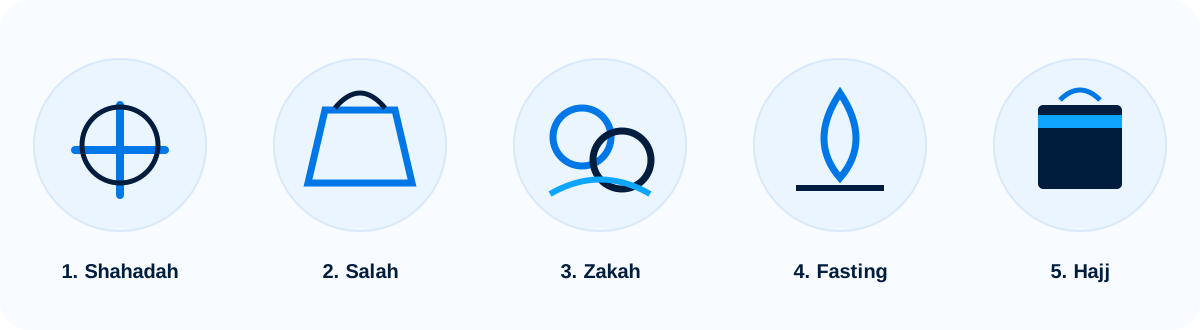
The Five Pillars give Muslim life a structure: Shahadah, salah, zakah, fasting Ramadan and Hajj for those able to perform it. Prayer gives the day repeated moments of return. Fasting trains discipline. Zakah connects wealth with responsibility. Hajj connects believers across place, language and background.
4. Believe in the unseen foundations of faith
Iman includes belief in Allah, His angels, His Books, His Messengers, the Last Day and divine decree. These are not abstract trivia. They shape how a Muslim understands life. Belief in accountability changes choices. Belief in Allah’s knowledge changes how we behave when nobody else sees us. Belief in divine decree helps us trust Allah without becoming passive.
5. Islam should improve character
If learning Islam makes someone more arrogant, dishonest or cruel, something has gone wrong. The Prophet ﷺ praised good character and modelled mercy, truthfulness, patience and restraint. Worship and character are not competing subjects.
This is especially important online. It is possible to consume religious content all day and still become harsher, more argumentative and more obsessed with winning than improving. Knowledge should humble us.
Is Islam only a set of rules?
No. Rules matter because life needs boundaries, but Islam also gives a worldview: where we came from, why we are here, who we worship, what happens after death and how to live with purpose now. It gives practices that train the heart and body, and principles for family, trade, justice, generosity and character.
Is Islam only for Arabs?
No. The Prophet Muhammad ﷺ was Arab and the Qur’an was revealed in Arabic, but Islam is not an ethnic religion. Muslims come from virtually every region and culture. The Qur’an describes human diversity as a sign and teaches that honour with Allah is tied to taqwa, not race or nationality.
Where should a beginner go next?
If this is your first serious introduction, do not jump straight into every controversial topic. First understand Allah, the Messenger ﷺ, the Qur’an, the Five Pillars and the Six Articles of Faith. Then learn purification and prayer. Once the foundation is clear, detailed topics are much easier to place in context.
Frequently asked questions
Do Muslims worship Muhammad ﷺ?
No. Muslims worship Allah alone. Muhammad ﷺ is loved, respected and followed as the final Messenger, but he is not worshipped.
Can someone be Muslim and still struggle with sins?
Yes. Muslims can sin and struggle. Islam teaches repentance, accountability and continued effort rather than pretending believers become flawless.
Do I need to understand everything before becoming Muslim?
No. A person enters Islam through sincere belief and the Shahadah. Learning continues afterwards, just as lifelong Muslims continue learning throughout their lives.
- Sahih Muslim 8a, Islam, iman and ihsan.
- Sahih al-Bukhari 8, the Five Pillars.
- Qur’an 112, Allah’s oneness.
- Qur’an 51:56, worship as human purpose.
What does Islam ask you to build?
Islam is not only a list of beliefs to agree with. It asks a person to build a life in which belief, worship, character and responsibility support one another. The Qur’an repeatedly connects faith with action. That is why a Muslim’s relationship with Allah should affect prayer, honesty, family life, money, speech, work and the way other people are treated.
A useful beginner framework is to think in four layers. First comes belief: knowing who Allah is and worshipping Him alone. Second comes worship: salah, fasting, zakah, du’a and other acts that train the heart. Third comes character: truthfulness, patience, mercy, modesty and justice. Fourth comes responsibility: applying Islam in real decisions rather than keeping it as an identity label.
What is the difference between Islam, iman and ihsan?
The famous Hadith of Jibril gives one of the clearest summaries of the religion. The Prophet Muhammad ﷺ described Islam through the testimony of faith, prayer, zakah, fasting Ramadan and Hajj. He described iman through belief in Allah, His angels, His Books, His messengers, the Last Day and divine decree. He described ihsan as worshipping Allah with deep awareness that He sees you. See Sahih Muslim 8a.
These are not three competing versions of religion. They show that Islam has outward practice, inward belief and spiritual excellence.
Where do rules fit into Islam?
Beginners sometimes meet Islam through a stream of halal and haram questions. Rules matter, but they make more sense when the foundation is clear. Islamic law is meant to guide worship, protect rights, regulate conduct and help people live responsibly before Allah. Learning individual rulings without learning Allah, prayer, the Qur’an and good character can make the religion feel fragmented.
Start with what is obligatory and recurring. Learn how to pray, how to make wudu, the basics of halal and haram that affect your daily life, and the responsibilities you actually face. Detailed questions can be learned when they become relevant.
What does a healthy first month of learning Islam look like?
- Week 1: understand the Shahadah and the basic belief in Allah.
- Week 2: learn wudu and begin learning salah.
- Week 3: establish a small Qur’an routine and learn a few authentic daily du’as.
- Week 4: review the Five Pillars, the Six Articles of Faith and the character Islam expects.
You do not need to master everything before moving forward. Consistent foundations are more valuable than collecting hundreds of disconnected facts.
Key sources
- Qur’an 2:21, worship Allah who created you.
- Qur’an 51:56, the purpose of worship.
- Sahih al-Bukhari 8, the Five Pillars.
- Sahih Muslim 8a, Islam, iman and ihsan.
Continue: Who is Allah? then learn the Five Pillars.